

Leeroy New x Eunice Andrada on Future Fiestas

‘How we celebrate is a hopeful act’
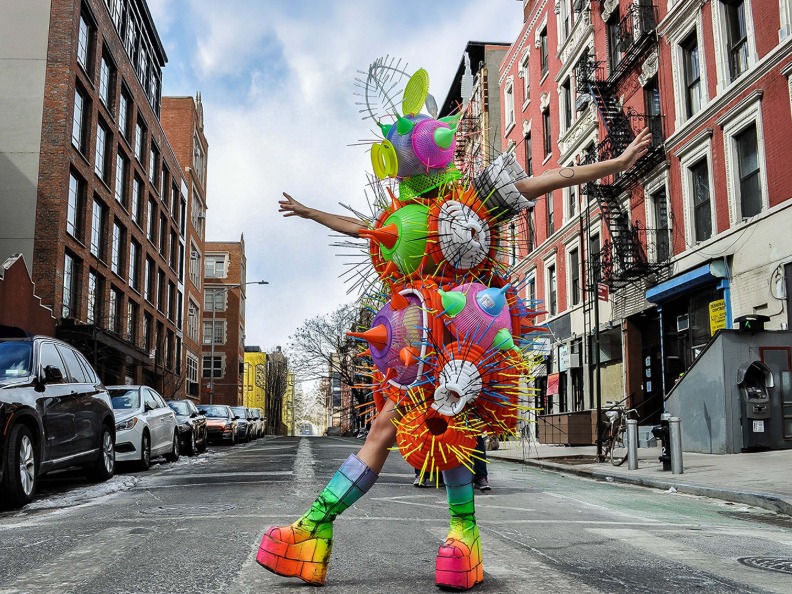
In our new Guest Features column, Sydney Festival brings Australian writers and artists together in conversation with the creative teams in our program to highlight and deepen the connections between our work and the wider local arts community.
He blips into my screen in a blur, the lush trees of Darug country flashing by behind him. My call has interrupted his tram commute to the studio where he will begin a 5-week creative process culminating in the presentation of Future Fiestas at Sydney Festival. Based in Manila, Philippines, Leeroy New is used to his art taking him to faraway places, having just arrived on Gadigal land after shows in Pinamar and Tokyo.
From first experimenting with discarded industrial materials in Bendigo in 2009 to featuring in the Sydney Biennale in 2023, New’s practice continues to deepen and grow. He returns to Australia now with a multi-part spectacle that fuses Filipino tradition with an otherworldly imagination. Future Fiestas will see him expand on long-held obsessions, from his evolving metaphor of the alien to community engagement in artmaking. “I wanted to apply my sculptural practice to accommodate movement, bodies, space, and the public. We thought the perfect vehicle for the integration of all these different things was the fiesta,” says New.
 Leeroy New
Fiestas in the Philippines are riotous, sweat-soaked affairs of costumes, competitions, and community, with the implicit challenge of upping the ante every year. Future Fiestas will offer this familiar spirit, starting with a parade of twenty wearable costume-sculptures on the opening day of Sydney Festival. Described as a “float-slash-costume pageant”, towering sculptures up to four meters high will be flaunted by performers in a glorious procession. This is followed by a series of community art workshops which invite participants to create their own futuristic drag from recycled materials. As a culmination of these drop-in sessions, participants are invited to join the closing parade of fiesta aliens down Darling Harbour on the final day of the festival.
Reflecting on the anticipatory joy imbued in the project title, New imagines his art as a way for Filipino communities to participate in stories of future-making. “Growing up in the Philippines, in the South, especially pre-internet, we've only been the recipients of stories about the future and we're generally left out. My way of participating, but also rebelling, was to make my own futuristic forms, but using what was available, like bamboo,” says New.
But he notes the sinister undercurrents humming in the broader political context of his creative practice. The Philippines has been the destination for the world’s trash and hazardous materials, with reported cases of illegal waste importations from Australia, Canada, Hong Kong, and South Korea. It can be easy to romanticise the resilient spirit of Filipinos after every uncovered scandal of international exploitation, every devastating typhoon, while ignoring the colonial frameworks that continue to reproduce this disparity. How, then, do we reconcile all of this–the bursting karaoke-fiesta-joy-maximalism and the inundation of wastelands, factories, and data centres sprawled across the Philippines like alien colonies?
 Aliens of Manila, Leeroy New
For New, bringing in the signature Filipino “twisted sense of humor” is a way of coping with these tensions. “Transforming detritus, discard, surplus, garbage, and waste is a hopeful practice in itself. We’re transforming it into something celebratory, something that we use as costumes, as decor for our fiestas. How we celebrate is a hopeful act,” says New.
Many of his vibrant, surreal works appear as if they were zapped in from another time. Upon closer inspection, spectators are often surprised to find everyday domestic materials, like washing machine hoses, pipes, and transformed plastics. The costumes of Future Fiestas will weave together materials that were the stars of his previous works, like bamboo, blue bottles, pipes, and toys, along with newer experiments with organic materials like cogon grass.
Sourcing materials from social enterprises like ANTHILL Fabric Gallery in Cebu and Rags2Riches in Quezon city, New’s process of gathering mirrors the act of fiesta preparation itself–a procession from barangay to barangay, collecting contributions for the extravaganza.
 Atlantis, Leeroy New
Now, the gargantuan challenge of physical labour and problem-solving in this amalgamation is a process that he says demands both “stubbornness and persistence”. New likens his artistic labour to migrant labour, particularly his mother’s work as a nanny in New York, with the artist and the Overseas Filipino Worker (OFW) out of context in foreign lands, yet occupying space in their own rebellious ways. He credits the isog (hard-headed bravery) that his Bisaya mother passed down to him as the force that has propelled his artistic practice.
“We were taught to create demure works in the Philippines, you know? Works that fit into a living room. And I guess creating works that are worn, performed and built in public spaces in a large scale was something that my younger self would not have expected. But I think he already knew. He had a glimpse of it.”